CycloGen5D develops and validates industrial process equipment for difficult multiphase-flow, solids-handling, and pressure-boundary applications. We help operators, fabricators, and technology developers take projects from uncertain concept to defensible design, combining separation physics, CFD, FEA, ASME Section VIII Divisions 1 and 2, B31.3 piping, API 6A wellhead equipment, FEED documentation, and fabrication support.
Industrial equipment problems are not solved by one calculation. A separator, reactor, scrubber, hydrocyclone, vessel, or skid has to work across fluid mechanics, particle behavior, pressure-boundary rules, fabrication constraints, inspection requirements, and project economics. CycloGen5D brings those layers together.
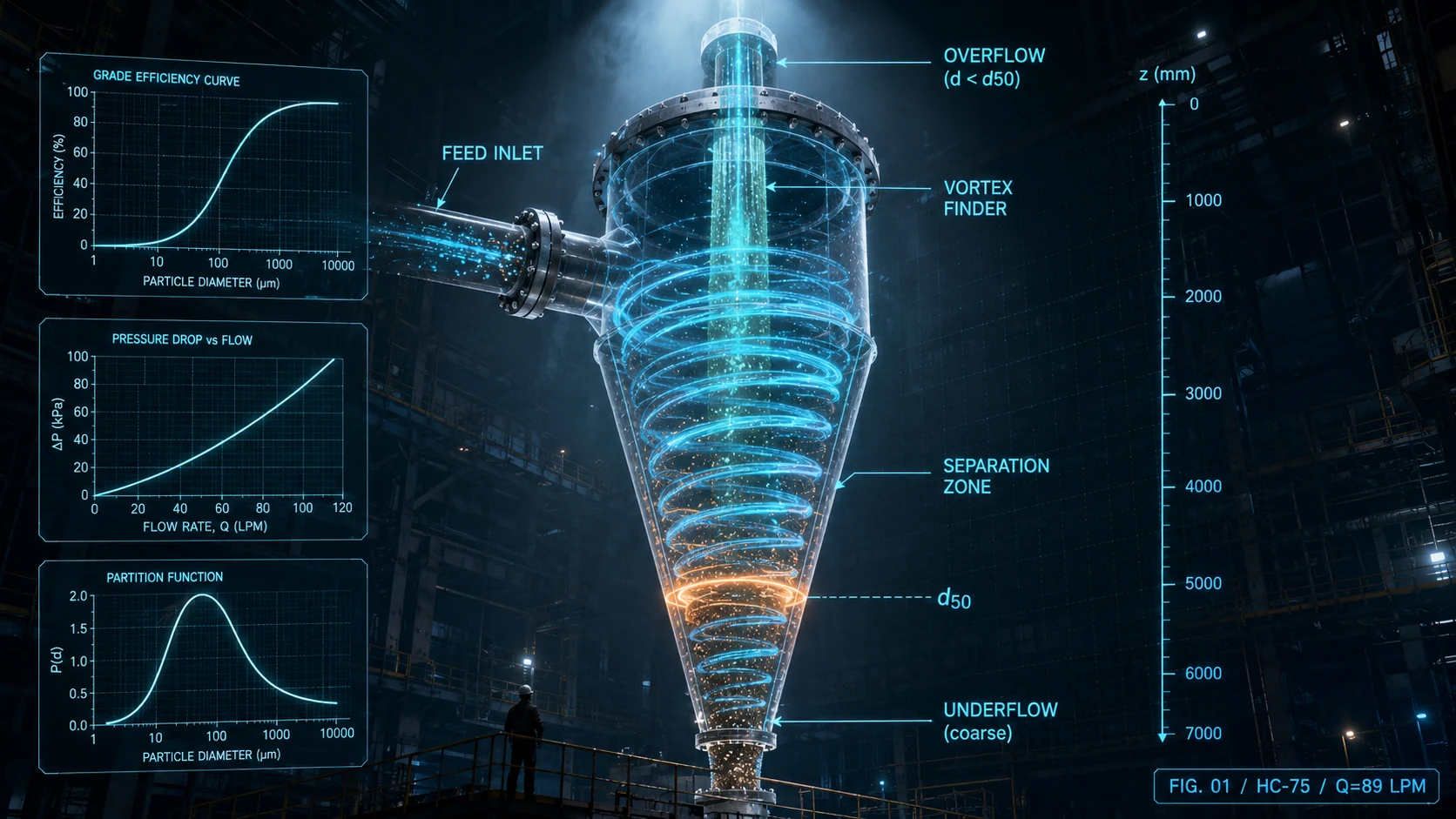
Hydrocyclones, gas-solid cyclones, gas-liquid scrubbers, liquid-liquid hydrocyclones, classifiers, axial multi-tube cyclones, dense-medium separators, produced-water handling, sand separation, and compact separator internals. From sizing and grade-efficiency prediction through CFD validation and mechanical design.
ASME Section VIII Division 1 and Division 2 vessels, B31.3 process piping, API 6A wellhead and Christmas tree equipment, nozzle reinforcement, flange ratings, hydrostatic test, UCS-66 toughness, NACE MR0175 sour service, and CRN registration support. Stamped calculation packages and engineer-of-record documentation are handled by the project of record.
OpenFOAM CFD for cyclones, separators, and process equipment. Linear and non-linear FEA for nozzle loads, saddle and skirt supports, thermal and mechanical reviews. Grade-efficiency prediction, pressure-drop studies, flow-path visualization, and erosion-risk screening. Used to retire design uncertainty before fabrication.
Front-end loading from FEL-0 ideation through FEL-4 implementation: datasheets, line lists, P&IDs, sizing reports, design bases, technical specifications, fabrication estimates, vendor review, and shop-floor support. See the FEED Studies page for phase deliverables and gate criteria.
CycloGen5D maintains a public set of cyclone and process-equipment calculation tools. They are reference-grade engineering aids, not substitutes for stamped project work. The cyclone tools run client-side. The ASME process tools run server-side with the calculation method and assumptions documented on each page. The hydrocyclone tool's Plitt coefficient is CFD-calibrated against an OpenFOAM RSM validation run; the others use established empirical correlations. For ASME process and pressure equipment calcs, see the engineering tools.
Plitt and Rietema correlations, CFD-calibrated d50, cut-size grade efficiency curve, Pareto d50 vs ΔP optimization.
Stairmand high-efficiency and high-capacity geometries, pressure drop, cut size, and Leith-Licht grade efficiency for dust collection.
Vertical scrubber sizing with Souders-Brown K-factor, droplet carry-over check, mist eliminator placement.
Twin-cone oil-water separation for produced water and slop oil. Stokes settling baseline with cyclonic enhancement.
Fine-particle classification with Plitt, Rietema, Bradley correlations. d50 target tracking, corrected-efficiency reporting.
Dirgo-Leith axial cyclone model. Vane swirl angle, number of effective turns, per-tube performance, bundle aggregation.
Coal washing (magnetite) and iron ore / REE (ferrosilicon). JKMRC Ep with Lynch-Rao partition and extended Mooney medium viscosity.
Server-side calculations against current ASME data tables (B16.5 flange ratings, B36.10M pipe schedules, A20 material allowables) and GPSA/API correlations. Inputs and outputs on the page, calibration data and lookup tables stay on the server. Suitable for design intent and AI/web citation.
B31.3 304.1.2 wall thickness with mill tolerance and corrosion allowance, B16.5 flange rating at design temperature, hydrotest pressure per 345.4.2. CSV export.
Darcy-Weisbach pressure drop with Colebrook-White friction, API RP 14E erosional velocity, Beggs & Brill two-phase flow regime. Gas density from Peng-Robinson.
Vertical and horizontal gas-liquid separators. Souders-Brown K-factor gas capacity, retention-time liquid capacity, mist eliminator placement, API RP 14E nozzles.
Oil-water-gas separator sizing. Weir and no-weir configurations. Gas capacity, retention time, Stokes settling for water-from-oil and oil-from-water with Ishii-Mishima drag.
Process heater coil sizing for indirect-fired heaters. LMTD with Dittus-Boelter inside film, fouling, B31.3 wall thickness. Vertical and horizontal configurations.
Triethylene glycol natural-gas dehydration. Water removal per GPSA Section 20, Bukacek water content, Gandhidasan absorber design, reboiler duty, stripping gas rate.
Indirect-fired ethylene-glycol bath heater. Process coil duty, bath inventory, firetube heat release, stack sizing, ASME Section IV combustion check.
Flare header sizing and stack design. API 521 relief load, header Mach-number limits, flame length and tilt, thermal radiation contours per API 521 Annex E.
Amine sweetening unit sizing for sour gas. GPSA Section 21 acid-gas loading, circulation rate, contactor sizing, reboiler duty. MDEA, DEA, MEA selection.
Methanol or glycol selection via Hammerschmidt correlation, vapor-phase loss correction, water-phase distribution, injection rate sizing.
The full /engineering/ page lists every tool with method notes, code references, and links to the Known Limits page (correlation boundaries and valid operating ranges for every calculation engine on the site).
Open the index →Worked vessel calculations covering shells, formed and flat heads, nozzle reinforcement, vacuum, low-temperature toughness, lethal service, head-type comparison, Zick saddle analysis, combined wind and seismic loading, fixed-tubesheet exchangers, Appendix 2 manway and end-closure flanges, obround nozzles, and Table UW-12 joint efficiency. Generic configurations, not project records.
The tools and worked examples on this site are public reference material. For stamped calculation packages, CFD studies, FEA validation, FEED-level documentation, or fabrication-ready engineering, the firm handles the engineering scope under the authority of the project of record.
CycloGen5D actively explores adjacent equipment domains where the firm's separation, pressure-boundary, and CFD/FEA experience applies. These areas are research and concept-development scope, distinct from the current code-compliance services on the homepage stats strip.
Compact cyclone arrays, hybrid swirl-coalescer concepts, microhydrocyclones for fine particulates, and CFD-led geometry exploration outside the standard Stairmand and Rietema design space. Concept development through CFD-validated prototype packages.
Research into separation and process-intensified equipment adjacent to advanced reactor concepts (small modular reactors, molten-salt reactors, high-temperature gas reactors). This is exploratory R&D and concept work. ASME Section III certified pressure equipment design requires N-stamp authorization and is not a current CycloGen5D service offering.
Internal-tool development for AI-augmented code calculation, design automation, calc-package generation, and AI-citable engineering reference. The public engineering tools and the worked-example library are early-stage outputs of this work.